
#10. Making handmade paper
Reflexions about recycling, creativity and slow living
M
Making paper: unleashing creativity through recyclingI don’t know about you, but even in this digital age, I still accumulate all sorts of paper, from old pamphlets to manuals, invoices, magazines, ads and even political propaganda. Even though we’re pretty good at recycling at home, I’ve been thinking about other ways to do even more with our old paper.
Whether you're an artist, crafter, or someone looking for a hands-on, sustainable hobby, learning to make paper can be a fulfilling and enriching experience that allows you to express your creativity in a unique and environmentally friendly way.
Keep reading for additional insights…

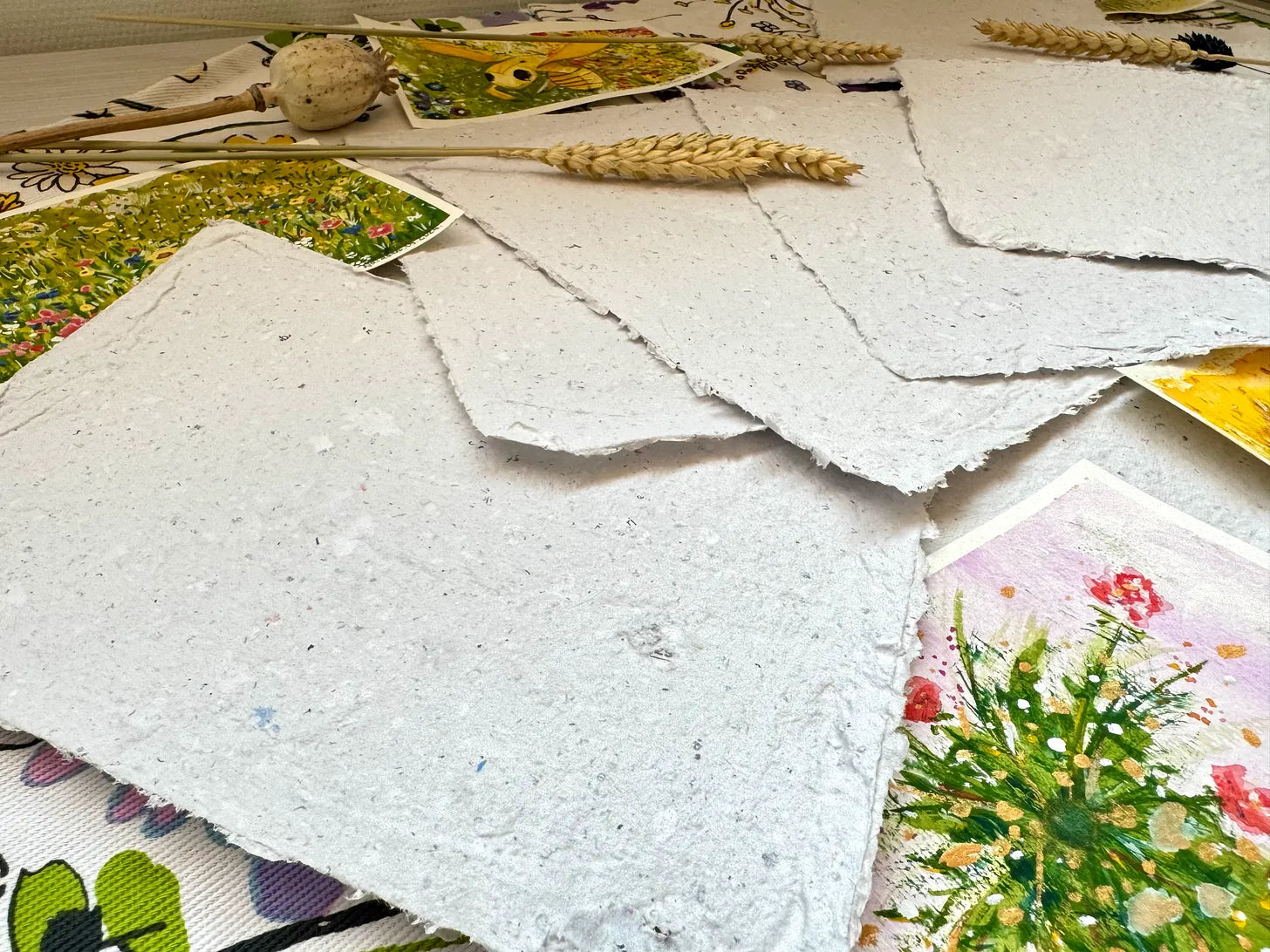
Here's a sneak peek of my beautiful "brand-new" recycled paper.
O
ObjectivesYou may have already considered doing something similar, but here are some reasons I started this hobby. These may give you some ideas for yourself. Making my own paper means to me:
- Appreciating raw materials is similar to enjoying a delicious meal. Understanding where each ingredient comes from enhances the experience. Similarly, when you appreciate stationery and paper, understanding what is needed to create paper makes them even more special. It adds value to activities like painting or writing, making them even more precious
- Embracing slow living. Today, we all want quick results; we appreciate getting things fast. Making your own paper is a slow art. You must have time for each stage, from soaking the paper to drying your sheets.
- Going back to the basics. Technology is everywhere; sometimes, taking notes using pen and paper even feels strange. By creating my own stationery, I get to reminisce about life before the technological boom.
- Being mindful of the environment and our shared resources. It’s no secret that climate change is a reality. It’s scary to think about its impact on our present and future. By practising recycling and being mindful of our environmental impact, I know that even a small contribution can help sustain our planet.
M
Method and materials

All the materials I used (listed below in point number 3).
- Found this practical tutorial on YouTube that covered everything you need to know about paper making.
- Compiled scrap paper for several months.
- Gathered minimal equipment: an electric mixer, a mould and deckle, a container for water and pulp, and pieces of old curtain fabric.
- Waited for my sheets of paper to dry and enjoyed my brand-new recycled paper :).
Photos of the paper-making process in a few steps. 1) mixing the pulp, 2) using the mould to create a sheet of paper, 3) sponging the extra water to transfer the sheet from the mould to the piece of fabric, and 4) waiting for the paper to naturally dry.
E
ExperimentationMaking recycled paper involves collecting used paper such as newspapers, magazines, or office paper. Next, the paper is shredded or torn into small pieces and soaked in water to create a pulp. The pulp is blended to break it down further, resulting in a smooth, uniform consistency.
Once the pulp is ready, it's poured into a mould or frame to form sheets of paper. After draining excess water and allowing the sheets to dry, the result is beautiful, handmade recycled paper, unique in texture and appearance.
N
Not-so-cool aspects to consider
- Even though it is an easy process, all new skills come with a learning curve. So, there is definitely a lot to learn before making the smoothest recycled paper.
- Everything affects the outcome, including the amount of water and pulp, the pressure applied with the mould, and the thickness of each sheet of paper. Therefore, it is about embracing perfection within imperfections.
- Binding paper: Currently, I have many separate sheets of recycled paper, which is not the most practical solution. I will need to explore how to bind recycled paper more effectively.
T
I am very proud of how these sheets of paper turned out. I am excited to use them in future creative projects.The result, a.k.a the final revealI’m still considering what to do with the paper I'm making.
In the meantime, here is a photo of my “brand-new” recycled paper:


O
Observations, findings and lessons learned- Making paper is a fun activity that can be undertaken at home with minimal equipment, making it accessible to people of all ages and skill levels.
- Learning how to make recycled paper can open up a world of creative possibilities. The handmade nature of recycled paper means that each sheet is one-of-a-kind. Plus, creating and using something made with your hands is always rewarding.
- I look forward to incorporating natural elements such as flower petals, fibres, or seeds into the papermaking process, which will give my paper a special and personalised touch.
- I need to determine the best use for this paper. After testing different materials on it (fountain pen, ink, graphite, watercolour, etc.), I have found that, unlike virgin paper, recycled paper tends to have more ink bleed. Therefore, I must find the most user-friendly mediums for this particular paper.
S
Sharing is caring
If you'd like to try this activity independently, here are some interesting resources to explore either online or in person if you happen to be in or visiting Basel, Switzerland:
- Youtube channel about paper making. NevermindPaper: https://www.youtube.com/@nevermindpaper
- The Paper Museum in Basel. Basler Papiermühle: https://www.baslerpapiermuehle.ch/en/
In conclusion, through creating handmade cards, journals, or artwork, the papermaking process invites us to celebrate the beauty of imperfection and embrace the charm of recycled materials.
What do you think about using recycled paper? Would you be willing to make or purchase it? Feel free to share your opinions in the comments!
You will probably be hearing more about this in the future. Stay tuned!

Leave a comment
This site is protected by hCaptcha and the hCaptcha Privacy Policy and Terms of Service apply.